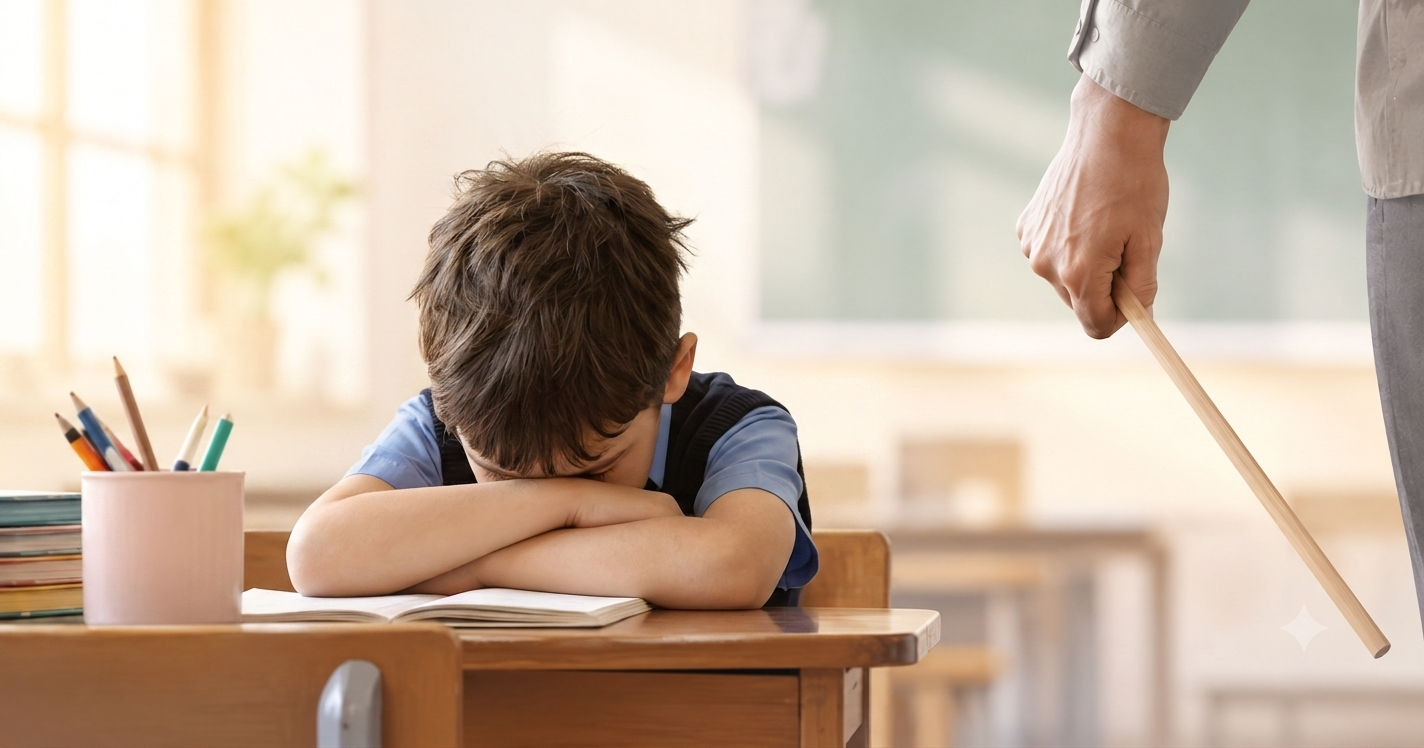
For one child, school is a place where teachers are expected to understand emotions, build confidence and make learning enjoyable. If a teacher humiliates the child or handles them roughly, parents are likely to question the school.
For another child, in the same country, school can mean something very different. A slap for getting an answer wrong. A stick across the hand for unfinished homework. Ears pulled, insults delivered in front of classmates, or the constant fear of being called to the front of the class.
The difference is not simply between private and government education. Pakistan has government schools, low-fee private schools in villages and urban neighbourhoods, expensive private schools and highly privileged institutions. The experience of a child can vary enormously between them.
This raises a difficult question: has the right to feel safe at school become another privilege in Pakistan?
The Numbers Are Difficult to Ignore
Corporal punishment in Pakistani schools is not simply something remembered by an older generation.
A study involving 1,752 sixth-grade students in 40 public schools in Hyderabad found extraordinarily high levels of corporal punishment. In the four weeks before being interviewed, 91.4 percent of boys and 60.9 percent of girls reported experiencing corporal punishment at school.
Another study, cited in a UNICEF report on violence against children in education settings in South Asia surveyed 3,582 Pakistani children aged 6 to 14 across eight districts. It found that 40.7 percent of children in government schools and 35.4 percent in private schools had experienced corporal punishment. Reported practices included slapping, caning and pulling children's ears.
The private-school figure matters. This is not a problem that can simply be labelled "government schools". Pakistan's private education sector includes everything from elite institutions to small, low-fee schools serving families with very limited choices.
Has a Violence-Free Education Become a Privilege?
Pakistan's education system reflects the country's enormous socioeconomic differences.
At one end are children attending highly resourced schools where emotional wellbeing, confidence and respectful communication may be part of the educational philosophy. Corporal punishment in such environments is increasingly unthinkable, and parents often have the knowledge and influence to challenge inappropriate treatment.
At the other end are children whose families may have few educational options. They may attend an under-resourced government school or a small, low-fee private school because it is what their family can access or afford.
A child's dignity, however, should not depend upon the fee their parents can pay.
The National Commission on the Rights of Child's State of Children in Pakistan 2025 identifies violent discipline as a continuing child-protection concern in Pakistan. The report notes that severe forms of violence, including violent discipline, continue to occur at home and in schools.
The question is therefore not only whether every child has access to a classroom. It is what happens to that child after entering it.
A Frightened Child Is Not a Better Learner
Physical punishment is sometimes defended as discipline. The child becomes quiet. The homework gets completed. The class comes under control.
But fear can produce immediate obedience without producing learning.
The World Health Organization's evidence on corporal punishment finds no positive outcomes for children. Corporal punishment is associated with physical and mental health problems, impaired cognitive and socio-emotional development, poorer educational outcomes and increased aggression.
A large meta-analysis of research on school corporal punishment reached a similar conclusion. It found school corporal punishment to be associated with internalizing problems, externalizing behavioural problems and poorer school performance.
A child who is frightened of making a mistake may stop raising a hand. A child who expects humiliation may avoid asking for help. A child who associates mathematics, English or science with being struck for a wrong answer is learning something beyond the lesson itself.
The child is learning that mistakes are dangerous.
That is almost the opposite of what education requires.
When Leaving School Feels Safer Than Staying
Pakistan's school dropout crisis has many causes. Poverty, child labour, distance, gender, family circumstances and the quality of education all matter.
Violence at school must also be part of that conversation.
The World Health Organization identifies school dropout and lower educational achievement among the negative outcomes associated with corporal punishment. The Hyderabad school study also examined the relationship between corporal punishment, school attendance and academic performance.
We often ask why a child "lost interest" in education.
Perhaps sometimes we should ask what happened inside the classroom before that interest disappeared.
For a child already struggling academically, repeatedly being slapped, caned or humiliated does not necessarily create motivation. It may simply make avoiding school feel safer than attending it.
When Adults Call Violence Discipline
Corporal punishment survives partly because adults have learned to give it respectable names. Sakhti, Strictness, Discipline,Teaching the child manners.
Some parents may even give teachers permission to "be strict" with their children, believing that fear will improve behaviour or academic performance. Teachers themselves may have grown up in classrooms where hitting children was considered completely normal.
This is how violence becomes intergenerational. What happened to us becomes what we permit for the next child.
Understanding that cycle does not require portraying every teacher as cruel. Teachers working in overcrowded and poorly resourced classrooms may themselves receive inadequate training and support in managing difficult classroom behaviour.
But difficult working conditions cannot make physical violence an acceptable teaching method.
Teachers need better tools for discipline. Children need protection. Schools need accountability. Parents need to stop measuring a teacher's seriousness by how frightened children are of them.
Parents Need to Ask One More Question
Parents naturally ask about marks, homework, tests and attendance.
But there is another question that deserves to become ordinary in Pakistani homes:
Do you feel safe at school?
Ask whether anyone hits them. Ask how teachers respond when they make mistakes. Ask whether they are humiliated in front of other children. Pay attention when a child suddenly starts resisting school, becomes unusually quiet about a particular teacher, or seems terrified of performing badly.
Education should challenge children. It should teach responsibility, persistence and discipline.
It should not teach them that the person holding the book is also someone they need to fear.
A country cannot promise education to its children while treating dignity inside that education as optional.
Every child, whether sitting in an expensive private school, a neighbourhood low-fee school or a government classroom, deserves more than a seat at a desk.
They deserve to feel safe in it.