Every August, the same thing happens.
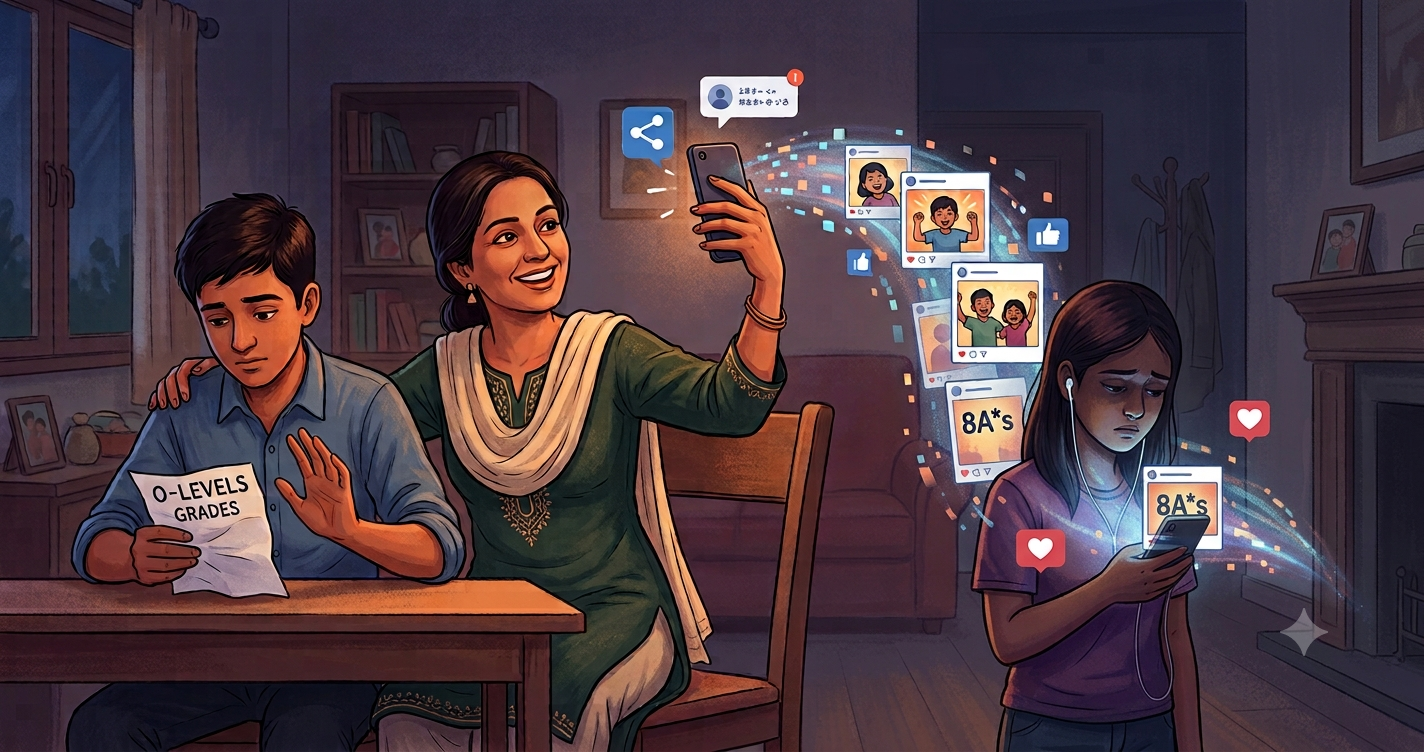
O Level results come out, and within an hour the timeline turns into a scoreboard. Screenshots of statements of results. Eight A stars. Seven A stars. A child holding a printout, smiling the smile of someone who has been told to smile. So proud of my son. So proud of my daughter.
There is nothing wrong with any single post. A mother is happy. Two years of coaching centres, past papers, missed weddings, missed sleep. She wants to say it out loud. That is human and it is fair.
The problem is not one post. The problem is twenty of them, stacked one after another, on a feed that another child is also scrolling.
Nobody posts a C
Look carefully at your timeline this week and notice what is missing.
You will not see a screenshot with three Bs and a C. You will not see a caption that says my son worked very hard and got exactly what he got. You will not see the child who failed one subject and is going to retake it in the winter session.
Those children exist. There are far more of them than there are eight A star children. They are simply not on the feed.
So what looks like a picture of a whole city's results is actually a picture of the top slice, repeated until it starts to feel like the standard. Not the exception. The standard. And a fifteen year old does not have the ability to correct for that. She does not think, this is a selected sample. She thinks, everyone did better than me.
This is the part we keep missing. We think we are sharing information. We are actually building a distorted average inside somebody else's child's head.
The child on the other side of the screen
Somewhere in your extended family there is a girl who got Bs.
She worked. She sat in the same coaching centre traffic. She was not lazy. She simply is not an eight A star child, because most children are not, because that is what the word average means.
On result day she opens Instagram. In four minutes she scrolls past nine posts from mothers she has met at weddings, all of them announcing children she has met at weddings. Her own mother has posted nothing. Her mother is being kind. But the silence has a sound, and the girl can hear it. In a culture where good news is announced, no announcement is its own announcement.
Now she waits for the phone calls. Beta, kya aya? And she has to say the number out loud, again and again, to aunts who already know what everyone else got.
We tell ourselves children do not notice. They notice everything. Pew Research has been asking teenagers for years how social media makes them feel about their own lives, and roughly one in four keeps saying it makes them feel worse That is not a headline about extreme cases. That is an ordinary Tuesday for an ordinary teenager. Result week just concentrates it.
Whose result is it, actually?
Here is the question almost nobody asks before posting.
Did you ask him?
The result belongs to the child. He sat in the exam hall. His hand cramped. His name is on the statement. The post, however, belongs to the parent. The audience is the parent's audience. The pride being displayed is the parent's pride. Somewhere in that transfer, the child stopped being a person and became content.
A sixteen year old is old enough to have an opinion about whether his marks should be public. Many of them do not want it. Some are shy. Some know their cousin did worse and do not want to be the reason for a bad evening in that house. Some just find it embarrassing in the way that everything a parent does is embarrassing at sixteen.
Very few will say no if you ask them casually in front of others. Ask privately. Ask like the answer matters. And if the answer is no, accept it without a lecture about how you are only proud of him.
And this habit is not a Pakistani invention. When American researchers asked parents about posting their children's lives online, about three out of four said they knew another parent who shares too much. Everybody can see the over sharing. Nobody can see their own.
The child who did well pays too
We assume the top scorer wins this exchange. Not entirely.
Once a number is public, the number becomes the child. He is now the boy with 8 A*s. That is his introduction at every dinner for the next two years. And the next exam, the A Levels, arrives with an audience already assembled and expectations already published.
There is a particular kind of anxiety that comes from having peaked in public. The only available outcome is maintaining. Anything less is a story.
Children who are praised for the score rather than the work learn something quietly dangerous. They learn that love arrives when the number is good. So they stop taking risks. They pick the safe subject, the safe university, the safe life, because the cost of an ordinary result is no longer ordinary. It is a family disappointment with witnesses.
So why do we share everything
This is the real question, and it deserves an honest answer.
Social media gave us the ability to broadcast. It did not give us the obligation.
Before all of this, good news travelled in a smaller circle. You called your mother. You called your sister. You distributed mithai in the office. Ten people knew, then thirty, and it stayed warm because it stayed small. The people who heard actually cared.
Now the same news goes to eight hundred people, and most of them are not family. They are your child's classmates. Your child's classmates' mothers. A woman you sat next to at a mehndi in 2019. A colleague who is quietly comparing your child to his own.
We did not decide to do this. We just kept using the tool the way the tool wants to be used, and the tool wants everything, all the time, immediately.
And there is a harder truth underneath. In a society where a mother's worth is still measured by how her children turn out, a result screenshot is a receipt. It says, look, I did my job. Nobody is doing anything wicked here. But it is worth knowing what you are actually posting before you post it.
The test is simple. Ask yourself who this post is for. If the answer is my child, tell him directly, and he will remember it far longer than a caption. If the answer is the aunties, then say that honestly to yourself and decide whether it is worth what it costs somebody else's daughter.
What to do instead
None of this means you must hide your child's success. Celebration is not the enemy. Broadcasting is.
Ask first, and mean it. His result, his call.
Consider a smaller room. The family WhatsApp group is not the public timeline. Twenty people who genuinely love your child will give you more real joy than four hundred likes.
If you do post, post the effort. The early mornings, the persistence, the subject he was terrified of and survived. Effort is something every child reading it can access. A grade is not.
Say the thing out loud at home first. Before you touch the phone, sit with him and tell him exactly what you admired about how he worked. Watch his face. That is the moment. The post is a copy of the moment, and the copy is always worse.
Wait a day. Result day pride is loud. Twenty four hours later you will still be proud and you will post something better, if you still want to post at all.
And if your child got a result that nobody is screenshotting, do not perform positivity. Do not say marks do not matter, because he knows they do. Say something truer. Tell him you know how much he put in. Tell him this is one exam in a long life, and that you are not going anywhere. Then put the phone down and take him out for something to eat.
The last thing
Your child will remember result week for a very long time. Not the grade. The feeling of it.
He will remember whether his house felt like a home or a press conference. He will remember whether his mother's first instinct was to reach for him or to reach for her phone.
You get to decide which one that is. Every August.