In our part of the world, a marriage lasting for thirty or forty years is often presented as an achievement in itself. We look at the years and call it success. We praise the woman who stayed. We admire her patience. We talk about how she kept her home together despite everything.
But perhaps there is another question we need to ask: The marriage survived. But did the people inside it survive too?
Because a marriage can remain intact on paper while a family slowly falls apart inside it.
When Patience Becomes a Lifetime
Every marriage goes through difficult periods. People argue. Financial pressures enter homes. Personalities clash. Couples disappoint each other. Marriage requires adjustment, forgiveness and patience from both people.
But there is a difference between a difficult marriage and a deeply dysfunctional one. When humiliation becomes routine, when one person lives in fear of another's anger, when insults replace conversation, when control is mistaken for authority, when someone is isolated from family, threatened, degraded or constantly made to feel worthless, we are no longer talking about ordinary marital difficulties.
And yet, this is often where society asks for even more patience. Give it time. Think about the children. Think about your parents. What will people say? Every additional year is presented as an investment in saving the family.
But sometimes those years are being taken from someone's life.
What Happens to the Woman Who Keeps Enduring?
A woman can become so accustomed to surviving that she stops noticing how much of herself she has lost. She learns to measure the mood of the house before speaking. She knows from footsteps, facial expressions or the sound of a door closing whether trouble is coming. She avoids certain subjects. She keeps quiet to prevent another argument. Her body may remain constantly alert even when nothing is happening.
Living under prolonged stress can take a real psychological and physical toll. Research has linked chronic stress and intimate partner abuse with higher risks of anxiety, depression, sleep problems and a range of physical health difficulties.
But statistics cannot fully describe what this can look like inside an ordinary life. Sometimes it is the woman who once had plans but no longer feels motivated to pursue anything. The woman who stops caring about how she looks or feels. The woman who is always tired. The woman who cannot remember the last time she did something simply because it made her happy.
Years pass, and by her forties or fifties, people may see an anxious, exhausted or emotionally withdrawn woman and ask, "What happened to her?" Perhaps the better question is: What has she been living through all these years?
Not every illness comes from an unhappy marriage, and not every woman living through marital conflict will develop mental or physical illness. But we should stop pretending that years of fear, humiliation and chronic stress leave no mark on a human being.
“Stay for the Children”
Perhaps no sentence carries more emotional weight than this one: stay for the children. It sounds selfless. It sounds like motherhood. It sounds as though leaving a harmful environment would damage children while staying automatically protects them.
But children do not experience a family through a marriage certificate. They experience it through the atmosphere of their home.
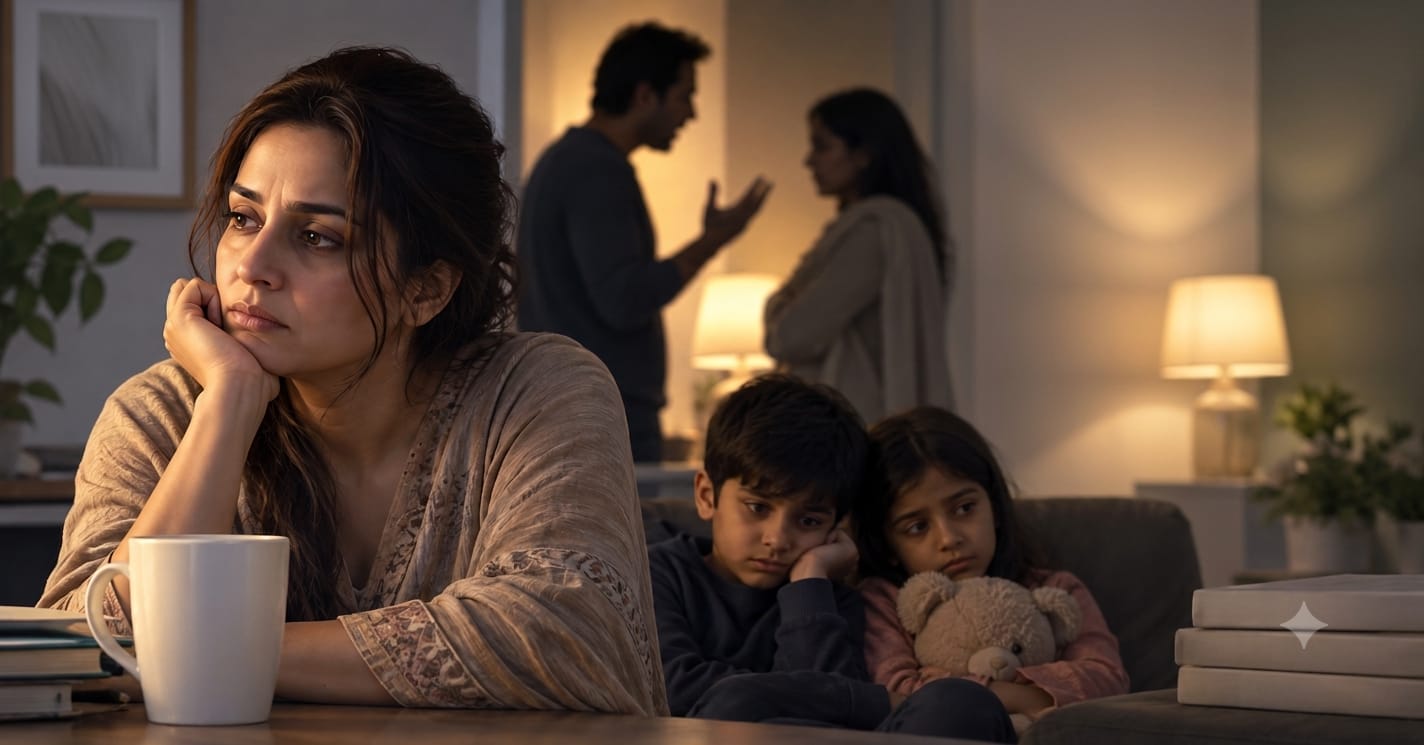
They hear the insults from the next room. They notice when their mother suddenly becomes quiet. They know when their father's arrival changes the mood of the house. They understand tension long before they understand marriage.
Some children become anxious. Some become unusually quiet. Some learn to please everyone because keeping adults happy feels like the safest way to live. Others become angry or aggressive. Some begin to believe that shouting, control, humiliation or emotional withdrawal are simply what marriage looks like. And sometimes the effects appear much later. A child can leave that house at eighteen and still carry it at thirty.
What Are We Teaching Them About Love?
Children learn relationships before they ever enter one. They watch how adults disagree. They learn whether saying sorry is weakness or maturity. They learn whether boundaries are respected. They learn whether love allows dignity or demands surrender.
A daughter who repeatedly watches her mother being humiliated may grow up believing that enduring pain is part of being a good wife. Or she may become terrified of relationships altogether. A son who grows up watching control and aggression being treated as normal may reproduce those behaviours. Or he may spend his adult life desperately trying not to become what he witnessed.
Of course, children are not destined to repeat their parents' lives. Many grow into thoughtful, emotionally healthy adults despite difficult childhoods. But why should healing from childhood become another responsibility we quietly hand them?
Are We Raising Sad Generations?
This is perhaps the part we discuss least. Dysfunction does not always end with the people who created it. Sometimes it travels.
One generation calls it patience. The next generation experiences it as childhood. Years later, that childhood enters another marriage, another home and another relationship. We then wonder why adults struggle with boundaries, anger, trust, attachment or self-worth.
Perhaps some of them are carrying emotional lessons they learned before they were old enough to question them. In trying desperately to preserve every family structure, regardless of what is happening inside it, we may sometimes be raising sad generations and calling that sacrifice.
Saving a Family Should Mean Saving Its People
None of this means that every troubled marriage should end. Some marriages heal. People change. Couples seek help. Harmful behaviours can be acknowledged and addressed. Relationships can be rebuilt when there is accountability, safety, genuine effort and change.
But preserving a marriage at any cost should never be our definition of success. A home is not successful merely because nobody left it. Success cannot simply mean that a woman endured until old age, that children learned to stay silent, and that the outside world never discovered what happened behind closed doors.
Before telling someone to save her marriage, perhaps we should ask what that marriage is asking her to sacrifice: her dignity, her health, her identity, her sense of safety, or her children's emotional wellbeing?
Because sometimes we become so determined to save the marriage that we forget something far more important.
The people inside it need saving too.