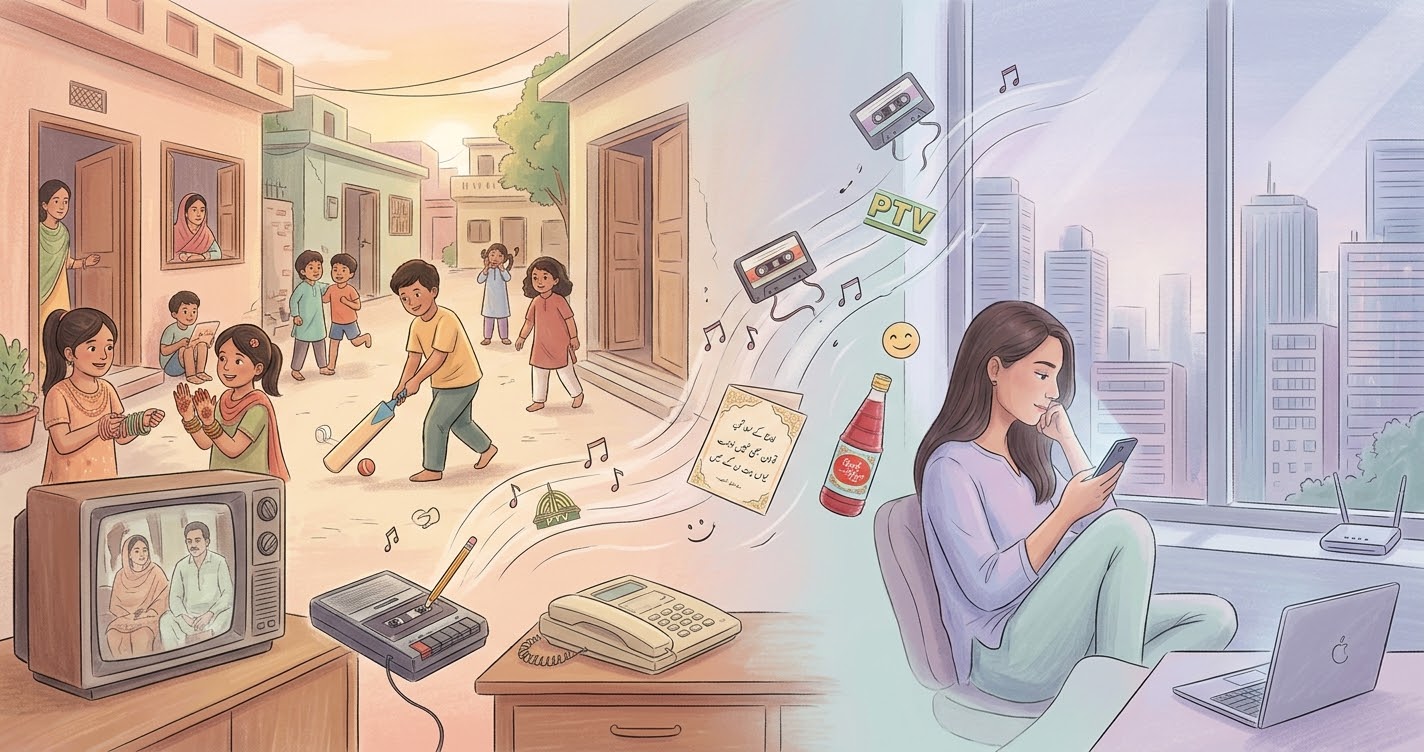
The generation born in the eighties has perhaps now entered the age when we are officially old enough to be called “Uncle” and “Auntie.”
The era that was once our life now walks beside us as a memory. Sometimes two lines of a song suddenly reach us from somewhere, sometimes the name of a drama or a scene from it, the tune of an old advertisement, the sound of a doorbell, a familiar fragrance, or some completely ordinary little thing opens an entire cupboard of memories. And then, for a moment, it feels as if time has blinked and we have arrived right back there... where we once truly lived.
Perhaps we really are among the last generations who opened their eyes in a world that almost no longer exists.
When Life Was Slower
We lived in a time when life was not fast. People had time, both for one another and for themselves.
Friendship did not mean sending a few forwarded messages on an app every day. We knew our friends’ families too. If a friend’s mother was unwell, someone from our home would send over a cooked dish. If there was a celebration, the whole family took part. And if you felt like visiting a friend, you did not first ask whether you were allowed to come. You simply knocked on the door.
And often, there was no need to knock at all.
The front door of the house was usually open.
As evening fell, the streets would fill with children. Someone had a ball, someone had a bicycle, someone was carrying a plastic doll, and someone was dragging a little brother or sister along with them. Toys were less a matter of personal ownership and more like shared community property.
Then came the Maghrib prayer call...
And suddenly, the same children who had been raising the roof of the street only moments earlier could be seen running towards their respective homes.
All it took was the watchful window of a neighbourhood elder and the trust mothers had that their children were somewhere nearby.
Television, Dramas and a Shared Childhood
We also watched television in a time when there was only one TV in the house, and the remote was often the property of one particular elder.
Before school, there was Mustansar Chacha’s voice, a few minutes of cartoons, and then getting ready for school.
Finding time to watch Tom and Jerry, Pink Panther, Bugs Bunny, and Popeye the Sailor Man, waiting for Ainak Wala Jin, and the strange silence that would descend over the house when a favourite drama was about to begin.
Andhera Ujala, Dhoop Kinare, Tanhaiyaan, Aroosa, Chand Grahan, Nijat, Dast, Jangloos, Marvi, Dhuwaan, Alpha Bravo Charlie, Family Front, Hawain, Sunehray Din, Nadan Nadia, Sitara, Mehrunnisa, Guest House...
These were not merely the names of dramas.
(Remember how we all cried our hearts out when Nabeel died in Dhuwaan? And even the acting of his fiancée afterwards did not feel like acting at all. It felt as if someone very close to us had left this world. Because whatever existed in those days, whatever it was, felt real.)
These were different parts of our growing-up years.
And Then There Was Music
And music?
Nazia Hassan and Zohaib Hassan, Vital Signs, Junoon, Shehzad Roy, Sajjad Ali, Doctor and the Professor, Strings, Hadiqa Kiani, Nusrat Fateh Ali Khan Sahib, Abida Parveen, Shazia Khushk...
Today’s generation may not even be able to imagine that getting a mix tape made with your favourite songs was once an entire project.
Begging your younger brother, carefully writing down the names of the songs, and then getting that little piece of paper to the audio-video shop.
And what if the cassette got stuck inside the tape recorder?
Well, no engineering degree was required. All you needed was a pencil and patience.
And when the tape became old and started getting stuck again and again, we were also the ones who knew that extraordinary technique of secretly putting it in the freezer without letting Amma find out.
Before Smartphones, There Were Landlines
We are the generation that saw the landline, and also knew how to protect it.
A wooden box in some corner of the house, a lock on it, and the moment the telephone rang, the whole household would become alert.
Only two or three houses in the neighbourhood might have a telephone, and those numbers were so important that relatives from half the neighbourhood would keep them written in their diaries. If a call came to someone’s house, a child would be sent running to deliver the message.
Then came the mobile phone.
And anyone who owned a mobile phone was considered a rather special person.
Calls were not free. Time was limited, and so was the conversation.
After two minutes, the phone itself would remind you: “Sir, love is one thing... but balance is something too.”
Ramadan, Eid and the Joy of Waiting
Ramadan also seemed more collective in those days.
Every household would send iftar to another household. There was never really a question of sending an empty plate back. It would simply return the next day with something else on it.
If Amma forgot to set the yoghurt before sehri, you ran to the neighbours.
Rooh Afza was made by the jugful or even the bucketful, with lemon, tukhm-e-malanga and ice... and still it felt as though the best drink in the world had been made in our very own home.
Eid was perhaps more beautiful too, because there was so much waiting involved.
Going to the market to buy Eid cards, searching for beautiful verses to write for your friends, giving each other mehndi, bangles and cards on the last day of school.
And Chand Raat...
Keeping the new clothes beside your pillow and looking at them again and again.
Trying on the new shoes, taking them off, and putting them on again.
Keeping the real mehndi, sealed inside a plastic bag, close by all night just to enjoy its fragrance.
Back then, you did not need very much to be happy.
A new outfit was enough.
The sound of bangles was enough.
A glass of Rooh Afza was enough.
Holding a friend’s hand and walking a few steps down the street was enough.
Having your favourite song come on television was enough.
Even straightening the antennas fixed to the rooftops from the evening onwards so that we could watch the Thursday feature film was an activity in itself.
We Lived Through the Change
Perhaps the real nostalgia of our generation is not about things. It is about feelings.
We watched the world change as technology entered our lives.
We travelled from cassettes to CDs, from CDs to MP3s, then to mobile phones, the internet, social media, and eventually to the world we live in today.
We were born before technology, but we were also among the first generations to embrace it.
We have lived in both worlds.
Perhaps that is why today’s world sometimes feels like a world with every possible convenience, yet somehow strangely restless.
Everything is available within seconds, but the joy of waiting is no longer there.
People are connected to one another all the time, yet somehow they are still so far apart.
Perhaps there are just as many joys today, but they can no longer be held in the palm of your hand.
Once, our palms held the fragrance of mehndi, the sound of Eid bangles, a card written by a friend, a little slip of paper with the names of songs, or sweets sent from a friend’s home.
Now there is a phone in our palm.
And perhaps that is the small difference that changed the entire world.
When an Old Song Opens a Door
So whenever an old song suddenly reaches your ears, when you come across the name of an old drama somewhere, when you smell an old soap or perfume, or hear the distant tune of an old television...
Pause for a moment.
It may not be just a song.
It may be a forgotten door into a part of your own life.
And behind that door may be the same child who once ran home from the street the moment he heard the Maghrib prayer call.
The child who could become incredibly happy with very little.
And perhaps...
The slight ache that still lives in the heart of our generation is for that very child.
Because we saw happiness from very close.
So close that we could hold it in our hands,
close our fingers around it,
and sometimes...
its fragrance would settle into our entire being.