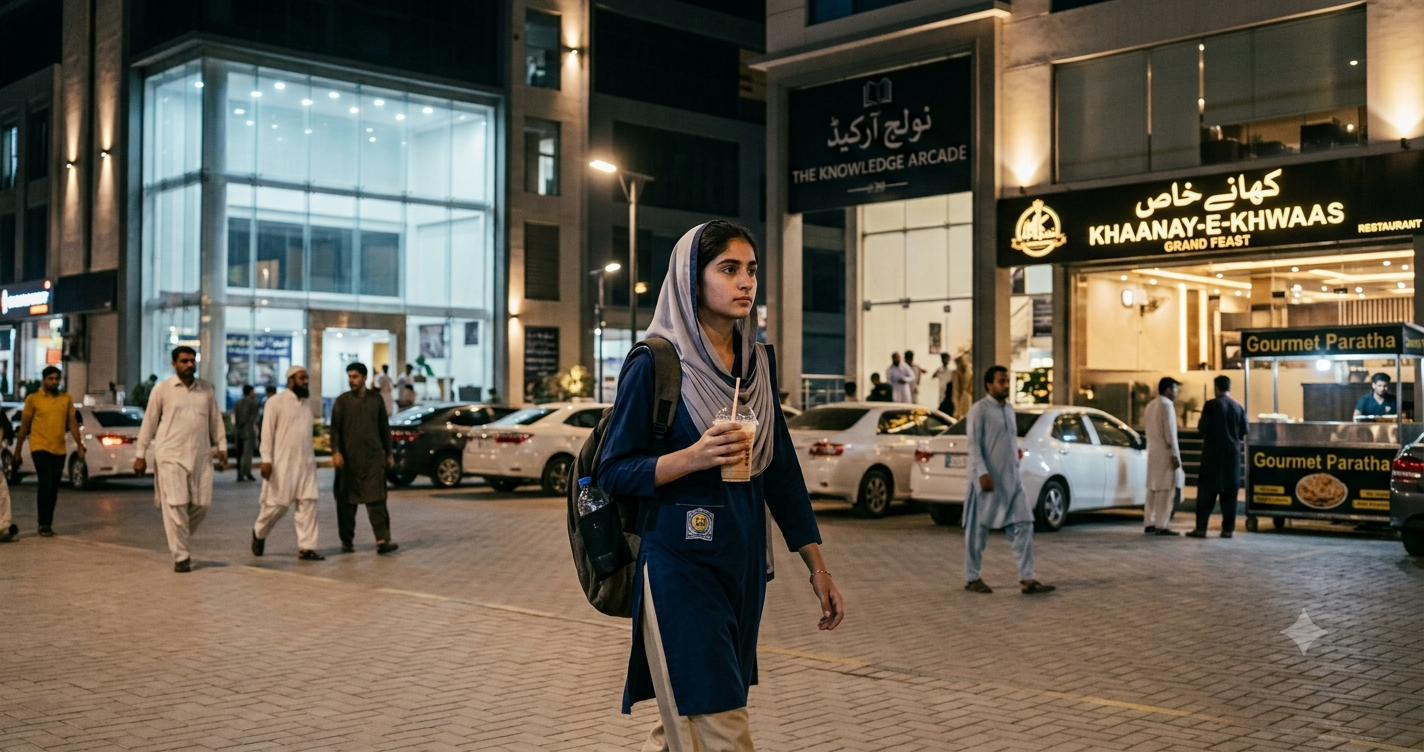
She leaves the house at seven in the morning. She comes back at nine at night. Somewhere in those fourteen hours, between school and the academy and the van ride in between, she eats something. Most parents could not say what.
Fourteen Hours Away From a Kitchen
This is the ordinary shape of an urban teenager's day in Pakistan now. School until two. A rushed hour at home if the timing allows, or no hour at all. Then tuition until eight or nine, sometimes two different centers in two different neighbourhoods. On weekends, test sessions.
Parents built this schedule. Parents pay for it and defend it at family gatherings when a relative asks why the child looks so tired. Almost nobody stopped to ask where the food was supposed to come from.
There is no kitchen in a coaching center. There is a canteen, if the child is lucky, or a stall outside the gate. There is a shopkeeper who knows exactly what a hungry sixteen year old with a hundred rupees will buy.
What the Day Actually Looks Like
Breakfast is skipped or swallowed standing. Tea, maybe a paratha, often nothing at all because the van is honking.
Lunch is whatever the school canteen sells. Patties. Chips. A cold drink.
The gap between school and tuition is the worst hour. The child is exhausted and low on energy and has money in a pocket. So it is samosas from the corner cart, or fries, or a packet of biscuits eaten on the back of a motorcycle.
Then, before the evening session, an energy drink. Because everyone else is drinking one. Because there are three hours of physics ahead and the eyes will not stay open otherwise.
Dinner happens at ten at night, in front of a screen, half eaten, because the stomach is already full of things that were never food.
The Cost Nobody Connects
Parents notice the headaches. They notice the stomach aches that arrive before every test and call them nerves. They notice that the child is irritable, that she sleeps badly, that she cannot focus at the desk they bought her.
So there is a doctor for the headaches. A better lamp for the focus. An instruction to sleep earlier for the tiredness.
Nobody connects any of it to the fact that she has not eaten a proper meal in three days.
A body running on fried starch and caffeine does not concentrate well. It does not sleep well. It does not sit through a three hour test without a crash. The very performance families are chasing is being quietly eaten away by the way the chase is being fed.
And then there is the part nobody says out loud. Caffeine loaded drinks at eight at night, four nights a week, in a body that is still growing. A cigarette found in a school bag would cause a household emergency. The energy drink is bought by the parents themselves.
This Is Not the Same for Every Family
Class belongs in this conversation, even though Pakistani parenting talk usually leaves it out.
A child collected by a driver with a lunchbox from home is having a completely different day than a child who takes two buses and eats what twenty rupees can buy. Coaching center canteens price food for parents, not for students. The cheapest item on the counter is almost always the worst item on the counter.
For many families, the tuition fee is already the sacrifice. There is nothing left over for food. So the child eats what the hundred rupees will stretch to, and it always stretches furthest toward oil and sugar.
This is not a discipline problem. It is not a child making bad choices. It is a system that takes children away from their homes for fourteen hours and accepts no responsibility for feeding them.
What the Academies Owe
Parents accept things from coaching centers that they would never accept from a school.
No break long enough to eat properly. No drinking water worth the name. A canteen contract handed to whoever pays the most, selling whatever sells fastest. Sessions scheduled straight through the evening with no gap at all.
These institutions are paid serious money. Asking about break timings is reasonable. Asking whether there is clean water is reasonable. Saying that a child who has been sitting since seven in the morning needs twenty minutes and a place to sit down and eat is reasonable.
Most parents have never asked once. The academies count on that.
What Can Actually Change Tomorrow
Not much, and that is the point. The small things are the only things.
Send food from home, even when she says she does not want it, even when it comes back untouched twice before she starts eating it. Send water, in something she is not embarrassed to carry.
Ask what she ate today, and ask it like a real question rather than an interrogation. Ask it before asking about the test.
Look at the schedule again and find the gap where a meal could go. If there is no gap, the schedule is wrong, not the child.
And sit at the same table with her sometimes, even at ten at night, even for fifteen minutes.
The Question Underneath
A generation of parents has decided that marks are the measure of love. They show up for the result day. They arrange the tutor. They pay the fee without blinking.
But somewhere in all that arranging, the children stopped being fed. Not because nobody cares. Because everybody was so busy caring about the future that they forgot the body sitting in front of them in the present.
She is not a machine that needs fuelling. She is a child who needs to be fed.