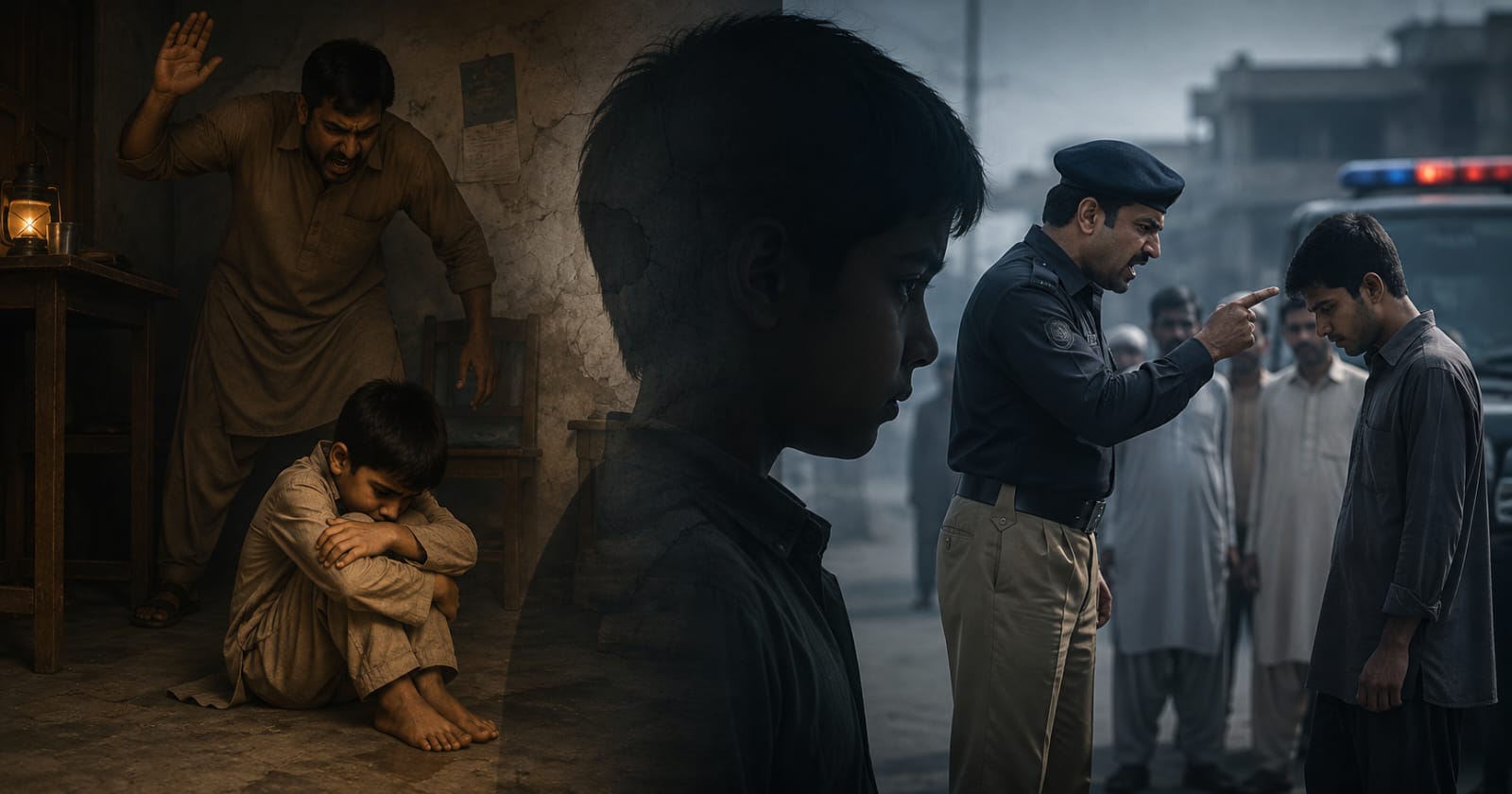
We've all met someone in a position of authority who seemed unnecessarily harsh, a police officer who humiliates people, a teacher who shouts at children, a supervisor who enjoys intimidating employees, or even a parent whose anger always seems just beneath the surface. It is easy to call such people cruel. It is much harder to ask how they became that way.
Sometimes, the answer begins decades earlier, in a childhood filled with fear, beatings, and humiliation.
Forty years earlier
He was just another boy growing up in a crowded home where money was always short and tempers were often shorter.
His father worked from dawn until late evening. His mother carried the endless weight of cooking, cleaning, and raising several children. They loved their family, but survival consumed them. There was little time for patience and even less room for mistakes.
A broken glass invited a slap.
Poor exam marks brought insults.
Answering back was unthinkable.
The boy learned to stay quiet, to read his father's mood before entering the room, and to hide his tears before anyone saw them.
When he started school, he hoped things would be different.
They weren't.
The teacher kept a stick beside the blackboard. Children were beaten for forgetting homework, making spelling mistakes, talking in class, or simply being too slow. Sometimes the punishment depended more on the teacher's mood than on the child's behaviour.
No one questioned it.
Parents often approved.
"Children only learn when they're afraid," people would say.
Without realizing it, the boy absorbed that lesson.
He began to believe that the strongest person in the room was the one everyone feared.
Years passed
He grew taller and stronger, but inside he still carried the frightened child who had spent years trying not to make mistakes.
Then one day, he achieved something his family celebrated with pride.
He earned a uniform.
Whether it was the police, the military, or another position of authority, people now listened when he spoke. For the first time in his life, he held power instead of living under it.
But a uniform can change a person's responsibilities.
It cannot automatically heal their childhood.
One afternoon, a frightened teenager stood before him after making a small mistake.
Instead of asking what had happened, the officer shouted.
The teenager lowered his head.
People nearby watched in silence.
No one saw the invisible classroom where a little boy had once been beaten for getting the wrong answer.
No one saw the frightened child who had learned that authority speaks through fear.
This is not the story of every police officer or every soldier
Far from it.
Many men and women in uniform come from difficult childhoods and become remarkable examples of patience, compassion, and integrity. Every day they protect people with professionalism and restraint.
But some adults, in every profession, carry wounds that were never allowed to heal.
When childhood teaches that love is mixed with fear, that mistakes deserve humiliation, and that the powerful are always right, those beliefs can quietly shape the way a person treats others years later.
The same pattern can appear in classrooms.
In offices.
In hospitals.
In factories.
And inside our own homes.
A teacher who humiliates students.
A manager who shouts at employees.
A father who believes fear is the only way to discipline his children.
Sometimes, they are passing on lessons they never chose to learn.
None of this excuses cruelty
Adults are responsible for their behaviour, regardless of what happened to them.
But understanding where harmful behaviour comes from helps us prevent it instead of simply condemning it.
Children who grow up with safety, respect, and emotional support are more likely to become adults who lead with those same qualities.
Children who grow up believing that power belongs to the loudest voice may spend years trying to unlearn that lesson.
That is why the way we raise children matters so deeply.
Every slap teaches something.
Every insult leaves a mark.
Every act of kindness teaches something too.
The question is not only what kind of adults we want our children to become.
It is also what kind of authority we want them to become when, one day, someone weaker is standing in front of them.
Because today's frightened child may become tomorrow's teacher.
Tomorrow's manager.
Tomorrow's police officer.
Tomorrow's parent.
If we want a kinder society, we cannot wait until people wear uniforms or hold positions of power.
We have to begin where every story begins.