There is a strange kind of haunting that happens on construction sites after dark.
The workers are asleep by nine. Not because they are tired, but because exhaustion has become their natural state — a gravity they cannot escape. They lie on unfinished porches, under corrugated sheets, on concrete that will one day be polished into marble hallways. A pedestal fan rattles somewhere. Mosquito nets hang like translucent ghosts. These are their beds. These are their homes. For now.
They are not from this city. They are never from the city where they build. They come from villages too small for maps, leaving behind fields that no longer feed them, mothers who age faster than the calendars allow, and sisters whose dowries depend on a brother’s calloused hands. They arrive with one bag, one set of clothes, and the understanding that they will leave the same way.
The house rises around them. Slowly. Then all at once.
They know every inch of it before the paint dries. They know which wall fought back, which beam sighed into place, where the foundation holds a secret crack. They have poured their mornings into its cement, their afternoons into its scaffolding, their evenings into guarding the very tiles they will never walk on barefoot. They sleep inside its skeleton long before it becomes someone else’s sanctuary.
And they will be gone before the owners move in.
This is the mathematics that breaks the heart: they spend years crafting permanence while living in absolute transit. They build kitchens where they will never cook. Bedrooms where they will never dream. Balconies where they will never stand with coffee at dawn. They construct beauty with their bare hands, then pack their one bag and walk toward the next site, the next city, the next mansion that will lock them out forever.
Imagine building a mosque and never being allowed to pray inside it.
The heat does not care if they are sick. The winter does not ask if their bones ache. The supervisor does not pause because a man’s fever is burning hotter than the cement mixer. They work because stopping means starving. Because somewhere in a village, a phone call is expected. Because the money is never enough, but it is all there is.
And then there are the nights.
The nights when the owners arrive — fresh from dinner, from vacations, from lives that do not bow to sunrise — and the engines of privilege roar to life inside the empty halls. The sound bounces off bare walls, amplified, inescapable. It reaches the porch where the workers sleep. It drags them awake. Not because they were waiting for it, but because some part of them is always braced for interruption. Always ready to serve the rhythm of someone else’s life.
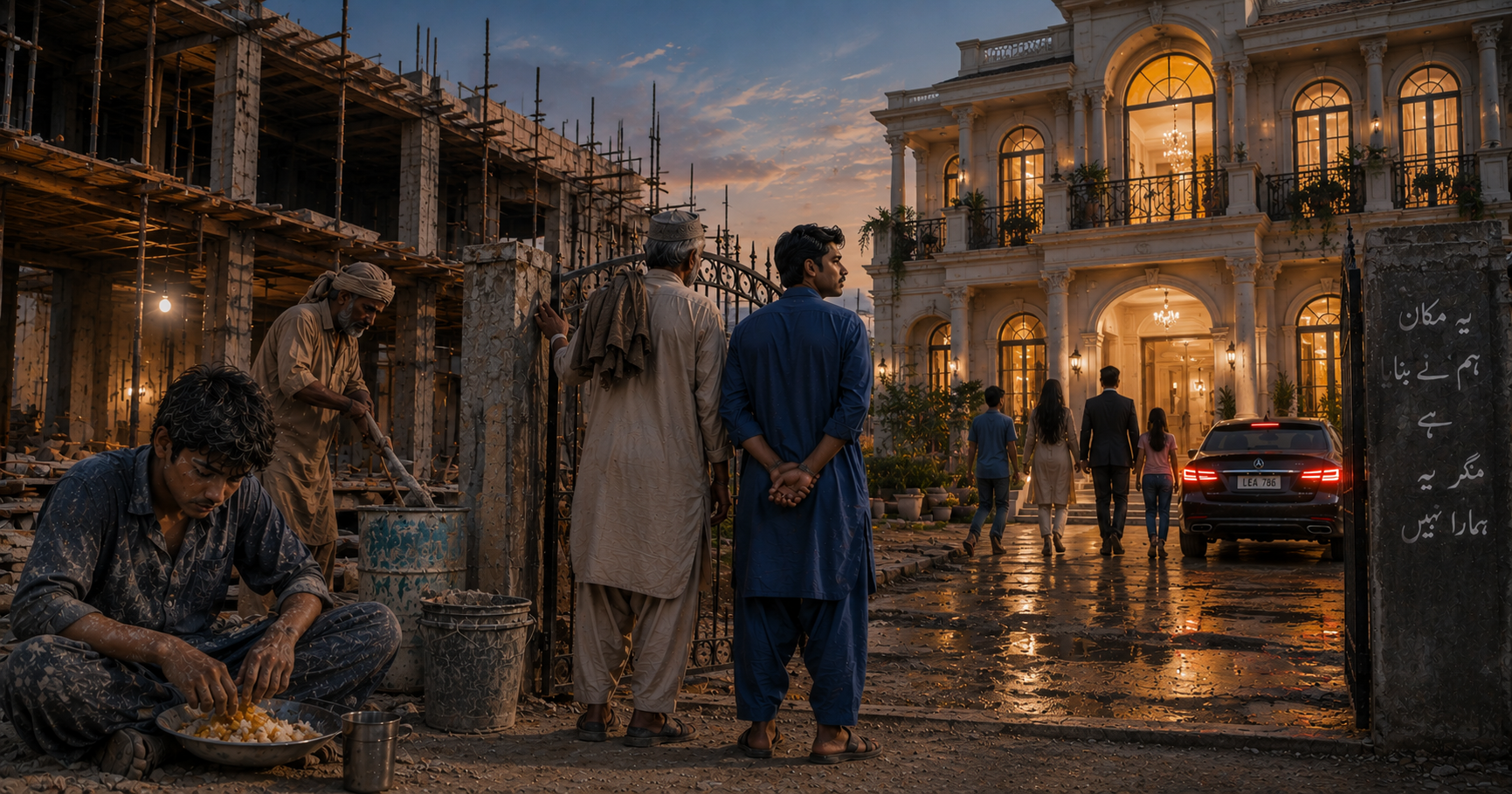
An old man rises. His son — barely twenty, with eyes that have already seen too much — follows. He is wearing the same blue shalwar kameez he wears every day, the fabric faded at the knees from kneeling on concrete, the collar softened by sweat and time. It is the only thing that marks him in the dark. That, and the look in his eyes.
They open gates they will never enter as guests. They close doors that will never have their names on the bell. They stand in the dark and watch the taillights disappear, knowing that when those lights return at 2 AM, they must be awake again. Ready again. Sacrificing the only rest they have, because the house demands it.
But the worst part is not the lost sleep. It is the look.
The look in the young man’s eyes when he watches the owner walk past — a man who moves through the world as if it were built for him, which, in a way, it was. The young man has touched more marble than most millionaires. He has carried more wealth on his shoulders than some see in a lifetime. But none of it is his. None of it will ever be his. And in that moment, standing in the dust of someone else’s driveway, his blue shalwar kameez catching the gate light, he understands, with a clarity that should not belong to someone so young, that he was born on the wrong side of the gate.
He looks at the owner’s children — boys and girls his own age, wearing the same years on their faces but living in a different universe. While they will climb to air-conditioned rooms and sleep until noon, he will return to the pedestal fan. To the mosquito net. To the concrete that holds his body but will never hold his name. He will wake at five. He will mix cement. He will build another paradise he cannot enter.
And if you look next door — really look — you will see it is not just him.
There is another boy there, younger still, probably in his mid-teens, sitting on the porch of the neighboring build. He is covered in cement. It dusts his hair, his arms, the creases of his fingers. He sits with a plate in his lap, eating quietly in the dark, too tired to wash himself before dinner. Behind him, an older man works still — mixing liquids into drums and buckets, stirring the paste that will smooth out someone else’s floors. The boy eats. The man mixes. Neither speaks. Neither rests. The house next door grows taller while they shrink smaller.
He is a child. He should be somewhere else. But his hands are already older than his face, and his dinner is eaten under the same stars that will soon demand his sleep, so he can wake and carry more cement.
When this house is finished — when the gardens bloom and the chandeliers hang and the family poses for photographs on the steps he laid — he will already be gone. Another site. Another skeleton. Another dream that belongs to someone else. Somewhere else, another gate will open in the middle of the night, and another young man in a faded blue shalwar kameez will rise from his sleep to close it. And somewhere else again, another boy covered in cement will eat his dinner in the dark while an older man mixes paste behind him.
The house will stand for a hundred years. It will shelter generations. It will be called a legacy, an investment, a home.
They will be footnotes in its history. Line items in its budget. Shadows in its foundation.
But if you listen — really listen — on a quiet night before the owners arrive, you can hear it. The house breathing. The concrete remembering. The walls holding, in their silence, the weight of every man and boy who built them knowing they would never be invited to stay.
That is the architecture of absence. That is the house that sleeps around them.