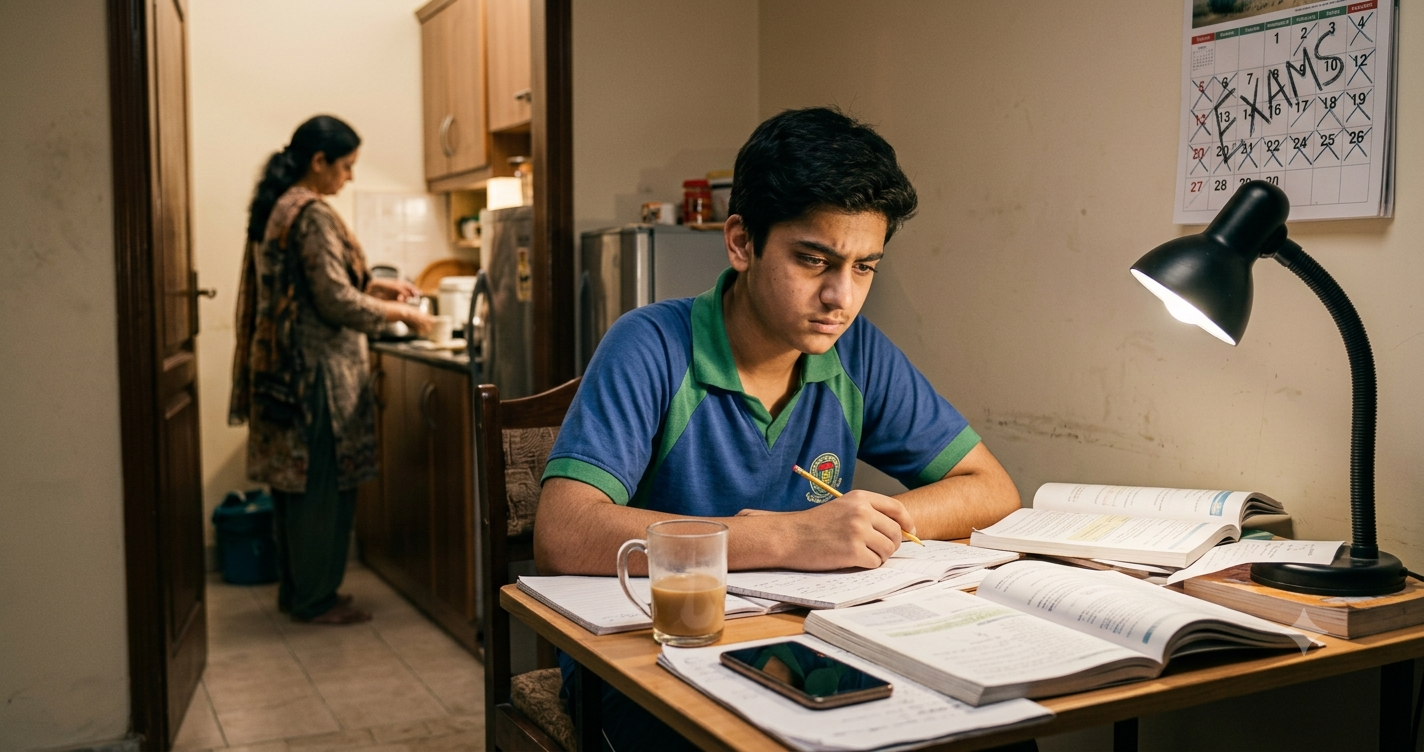
In most South Asian homes, exam season does not belong to the child. It belongs to the whole family. The television volume drops. The cousins are told not to visit. The mother wakes at three in the morning to make tea. And somewhere in that quiet house, a fifteen year old sits at a desk with a sentence hanging over him that nobody has to say out loud: hamara naam roshan karna hai.
We say it with love. We mean it as encouragement. A child does not hear encouragement. A child hears a debt.
Where the pressure actually comes from
Ask most parents in Pakistan or India why marks matter so much and the answer is honest. We have watched jobs disappear. We have seen merit lists shrink while the number of applicants grows. Many of us studied in conditions our children will never see, and we built something out of very little. The fear is real. Education felt like the one door that opened.
But somewhere the goal changed. It stopped being about the child's future and became about the family's standing. The result card turned into a public document. It gets discussed at weddings. It gets compared at Eid lunches. Chachu's daughter got ninety two. Your son got seventy eight. The silence after that sentence does more damage than any scolding.
What study stress looks like before it becomes serious
Children rarely say they are stressed. Instead, they show it.
He sleeps eleven hours and still looks tired. She keeps her books open for four hours and finishes two pages. He gets stomach aches every Sunday night. She stops eating properly, or eats constantly. He snaps at younger siblings. She stops telling you about school at all.
That last one matters the most. When a child stops sharing small failures, it is because small failures have become expensive. If a bad quiz or a test brings a lecture, the child learns to hide it. Then the bad term. Parents often find out at the very end, when the problem has grown too large for it to be solved quietly.
The cost we do not count
We measure the benefit of pressure in marks. We do not measure the cost.
Some of it is medical. Anxiety, panic before papers, headaches, disturbed sleep, and in older teenagers, depression. Our region loses young people every year in the days after results are announced, and those stories should stop the whole country. Most families never reach that point. Many reach something quieter and still serious: a young person who no longer believes he is worth anything except a number.
Some of it is moral. A child under this much pressure learns to protect himself. He copies. He lies about tuition attendance. He hides a paper. We call this a character problem. Often it is a survival response to a home where honesty is punished.
And some of it is simply lost. A child who is good with his hands, or with people, or with words, spends five years failing at physics because engineering carries the family name better.
What parents can actually do
Separate effort from result. Ask what he studied today, not what he scored. Effort is the only part he controls, so it is the only fair thing to judge.
Stop the comparisons completely. Not fewer comparisons. None. Comparing siblings and cousins does not create motivation. It creates resentment between children who should have been allies.
Make failure survivable at home.Say it out loud, once: if you fail a paper, tell me first, and we will handle it together. Then keep that promise the first time it is tested. That single moment decides whether your child comes to you for the next ten years.
Protect sleep and food. A teenager studying till two in the morning is not working hard. He is working badly. Memory settles during sleep. So does the ability to stay calm the next day.
Keep one thing that is not about studying. One sport, one instrument, one hour with friends, kept even during exam month. It is not a reward to be withdrawn. It is what keeps him steady.
Watch your own voice. Many of us repeat what our fathers said to us because we do not know another script. You are allowed to write a new one.
What naam roshan actually means
Here is the question worth sitting with. If your child grows into a decent, working, honest adult who is not a doctor, will you feel your name has been dishonoured?
Most parents, asked plainly, say no. But our children do not hear the plain answer. They hear the daily one. They hear the sigh at the result card, the phone call to the khala, the comparison at dinner.
A name is not made bright by a percentage. It is made bright by a child who grew up believing his parents were on his side. That belief lasts fifty years. A board result lasts a week.
Say it to him this week, before the next paper. Beta, I want you to do well. But I want you more.