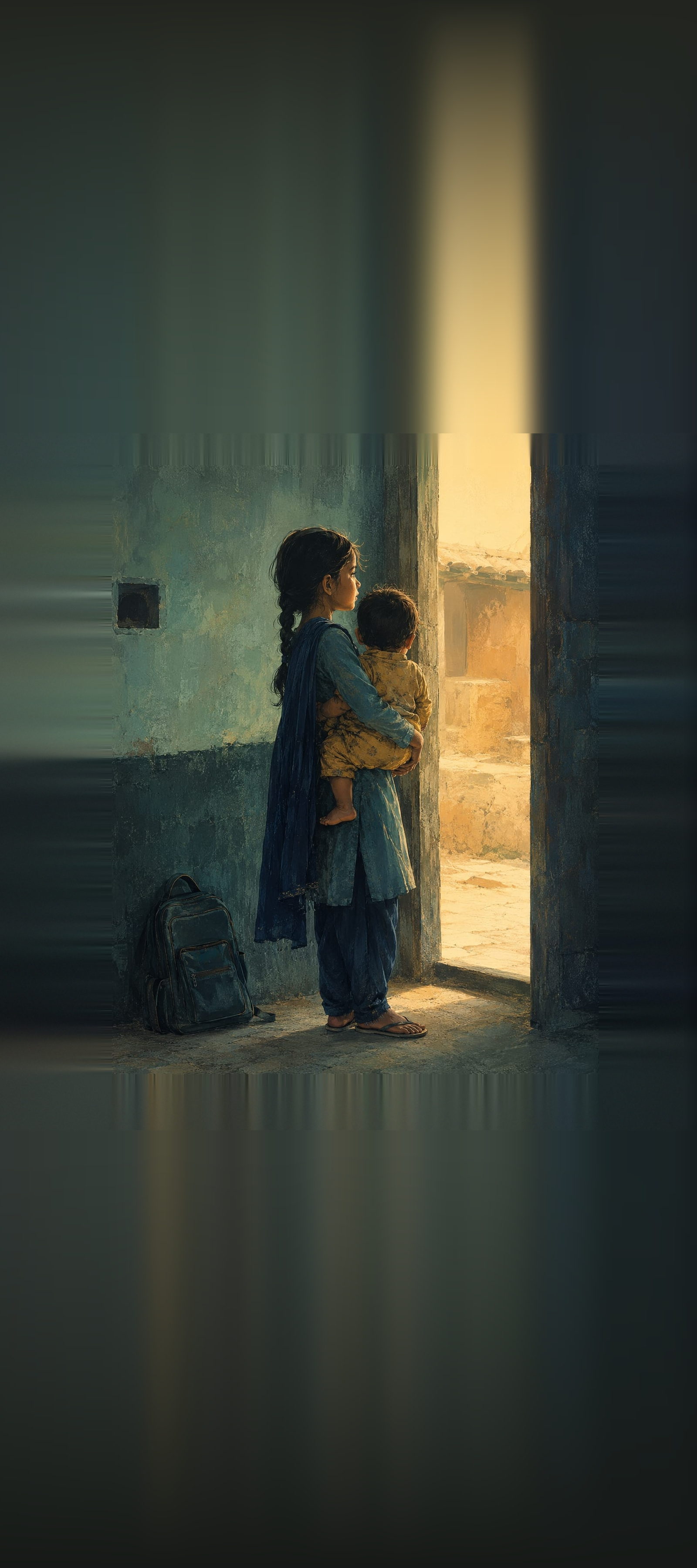
She was ten, maybe eleven. In a small mud or brick house, with barely enough room and barely enough food, she was already the second mother.
Not because her own mother didn't love her. But because her mother was pregnant again, she almost always was. In these homes, a baby arrives nearly every year. Not by plan. Not by choice, most of the time. Just by circumstance, tradition, and the absence of any other option.
Every new baby meant one more mouth, one more set of nappies, one more sleepless night. And someone had to carry that weight while the mother recovered, fed the newborn, and went straight back to work in the fields or the house.
That someone was always the eldest daughter.
No one sat her down and gave her the job. She simply saw the house falling apart around her mother's exhaustion, and she stepped in. By the time she was old enough to understand what was happening to her, it had already happened.
One Baby a Year, One Childhood Gone
This is the part people from easier lives don't grasp. It isn't one baby. It's baby after baby, year after year, in homes where nobody plans and nobody can afford to stop.
Each pregnancy takes the mother out of commission for months. Nausea, exhaustion, a body worn down by the last birth before it's even recovered. Someone has to run the house while she's down. There's no daycare. No nanny. No neighbor with free time. There is only the eldest daughter, growing up faster with every new sibling.
By the time she is ten, she is not just helping. She is raising children, bathing them, feeding them, calming them at 3 AM while she herself is still a child.
She wasn't born to be a second mother. She became one because childhood was a luxury her family couldn't afford
What she loses first is often not her childhood, but her chance at an education.
Her parents didn't necessarily want this for her. Many of them regret it, quietly, and never say so. But in a poor household, wanting isn't the same as being able to.
There is no money for help. No safety net. The math of survival is brutal. One less pair of hands in the house means the younger children go unfed, unwashed, unsupervised.
It rarely happens all at once. It happens in pieces. She misses a week when her mother is due. Then a month when the baby is sick. Then she's needed at home so often that going back doesn't make sense anymore. Nobody announces "your education is over." It simply stops being possible.
And she rarely fights it, because she's been taught by example, not by words. That this is simply what an eldest daughter does. She tells herself it's her duty. She doesn't recognize it as a loss. She thinks she is being good.
What Childhood Looks Like When It's Handed Away
We say she "lost" her childhood, but that word is too gentle. She didn't lose it. It was taken from her hands.
She gave up sleep for the baby who cried at dawn. She gave up play because a toddler needed watching every second. She gave up her books because there was no time left in the day that wasn't already spoken for.
She learned to wash soiled clothes, to settle a screaming infant, to move through the house quietly and constantly, doing what needed doing, never resting, rarely asked how she felt about any of it.
Somewhere in all this, she stopped expecting anything for herself. Not because she's naturally selfless, no child is, but because wanting things she couldn't have hurt too much to keep doing.
She watched younger siblings, sometimes even younger brothers, go to the school she no longer attended. She carried their bags. She helped with homework she would never get to do herself. And she was expected to be happy about it, because their success was the only kind she was allowed to feel proud of.
The Mother Isn't the Villain
It's easy to be angry at the mother in this story. But the reality is., she was very likely an eldest daughter once too, raised exactly this way, given no more choice than she is giving her own daughter now.
She's pregnant again, maybe for the sixth or seventh time. Her body is worn out. There's no rest coming. She's angry, not really at her daughter, but at a life that keeps handing her more children with no more help, no more money, no more strength.
That anger lands on the eldest daughter anyway, because she's the one closest, the one always there. The mother snaps at her, leans on her, treats her less like a child and more like a second self who can carry what she can't. She isn't trying to steal her daughter's future. She's trying to get through today.
She goes into that marriage the same way she went into everything else, without being asked, without being consulted, carrying responsibility that was never really a choice.