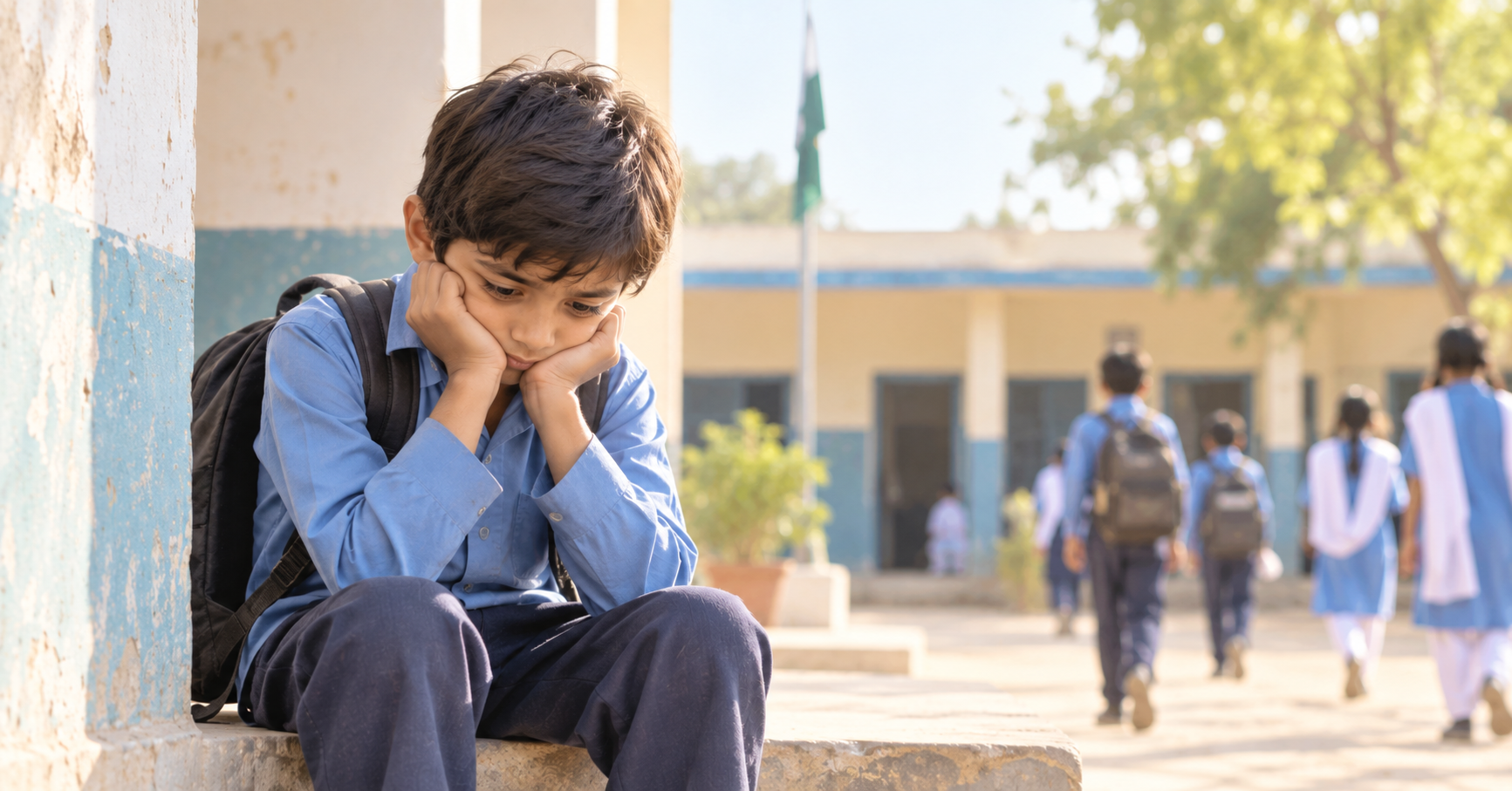
Some mornings, a child stands outside the school gate and says his stomach hurts.
His mother is already tired. There is work waiting for her, breakfast was made in a hurry, and there may be younger children at home. She looks at him and says, “You were fine five minutes ago. Go inside.”
Maybe he really does have a stomach ache.
Or maybe his body has learned to feel fear before he has learned how to explain it.
Perhaps yesterday he was slapped for getting an answer wrong. Perhaps the teacher hit his hand because his homework was incomplete. Perhaps he was made to stand in front of the class while everyone watched.
He does not have the words for humiliation, anxiety or fear of authority.
So he says, “My stomach hurts.”
And his mother sends him inside.
When School Is the Only Door
It is easy to ask why a parent would continue sending a child to a school where he is frightened.
The answer becomes harder when that parent has very few choices.
For many struggling families, education is not simply about grades or a good university. It represents escape.
A father who spent his life doing exhausting physical work may look at his son and think, You will not live like me.
A mother who never had the chance to complete school may tolerate things she does not like because she believes education is the one thing that can change her child’s life.
They may not have another school nearby. They may not be able to afford higher fees, transport, private tuition or repeated admission charges.
A financially comfortable parent can say, “This school is not right for my child.
For another parent, the choice may be this school or no school.
So when the child says, “I don’t want to go,” the answer is often simple: Beta, school toh jana hai.
Sometimes that sentence is not indifference. Sometimes it is helplessness.
When Pressure Follows Him Home
But school may not be the only place where the child is carrying fear.
Financial hardship does not make parents cruel, and poverty should never be used to excuse violence against children. But constant financial pressure can exhaust people.
Rent is due. Food costs more than it did last month. A bill is waiting. Someone needs medicine. School fees have to be paid. There is never quite enough.
Adults carry these worries, but sometimes their frustration falls on the person in the house with the least power.
The child.
He comes home after being punished at school. His mother asks why his marks are falling. His father sees an unfinished notebook.
“Why don’t you study? Do you know how hard I work for you?”
Another angry voice. Perhaps another slap. And there is a painful irony in it.
The teacher punishes him because he is not studying well enough.
The parent punishes him because he is not studying well enough.
Both believe education will improve his future. The child stands between them.
Everyone Has a Reason
Perhaps that is what makes this situation so complicated.
The parent has a reason.
The teacher may have one too.
A teacher managing a crowded classroom with limited resources, little support and pressure to produce results may believe strict discipline is the only way to maintain control.
The school wants children to perform.
The parents want their sacrifices to mean something.
None of these reasons make hitting or humiliating a child acceptable. But understanding the pressures around adults helps us see something important.
Sometimes there is no single villain in a child’s story.
There is simply a chain of pressure, moving from one person to another, until it reaches someone too small to pass it anywhere else.
He Still Needs Somewhere to Feel Safe
We talk constantly about children’s futures.
Study now so you can have a good life later.
Work hard now so you do not struggle like us.
Bear some difficulty now because one day you will understand.
There may be love behind many of these sentences.
But childhood is not merely a waiting room for adulthood.
A child needs education, but he also needs dignity. He needs discipline, but not fear. He needs adults to prepare him for life without making the life he is living today unbearable.
Perhaps when a child repeatedly says his stomach hurts before school, we should ask one more question before calling it an excuse.
Perhaps when his marks suddenly fall, we should ask what changed before deciding that he has become lazy.
And perhaps when we are angry because he is not studying, we should remember that fear does not always produce better learning. Sometimes it simply produces a quieter child.
The parent wants him to escape poverty.
The teacher wants him to pass.
The school wants results.
Everyone is preparing him for tomorrow.
But who is protecting his today?