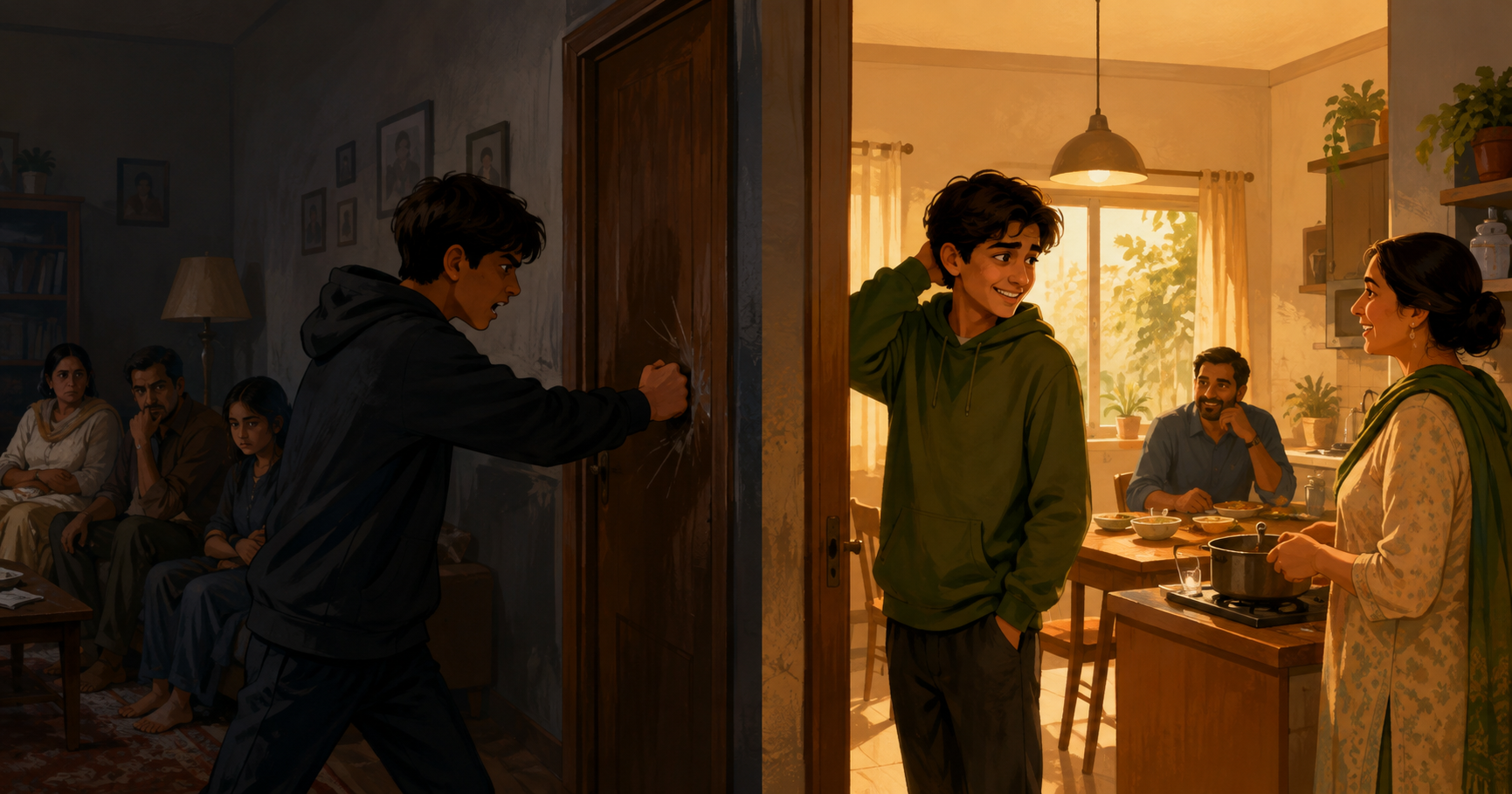
Two boys, both fifteen, both in the same grade at the same school in the same city.
One slams a door and the house holds its breath for three days. The other slams a door, and forty minutes later he is in the kitchen asking what is for dinner, faintly embarrassed and already halfway back to normal.
Parents notice these differences all the time. At family gatherings, in WhatsApp groups, in the quiet comparisons we make while watching someone else's child speak politely to an elder.
And we usually reach a moral conclusion.
That boy is well brought up. This one has been spoiled. That family is lucky. This family failed somewhere.
But the difference between those two boys is rarely whether anger exists.
It is what the anger runs into.
Teenagers Are Going to Get Angry
There is no such thing as a teenager who never gets angry, acts carelessly, forgets what he was told twice, or says something at dinner that he will cringe about at twenty-five.
If you are waiting for an adolescence that skips all of this, you are waiting for something that does not exist.
And much of it is not a character flaw. It is part of growing up.
During adolescence, emotions can be powerful while the ability to pause, think and control an immediate reaction is still developing. Add lack of sleep, physical changes, academic pressure and a social world in which small things can feel enormous, and you get what many parents recognise: big feelings and a very small pause between feeling and reacting.
So when a mother says, “My son has suddenly become so disrespectful,” she may not be witnessing a moral collapse. She may be watching adolescence arrive.
Which leaves a more useful question:
If teenage anger is normal, why does it shake one household much more than another?
The Home Does Not Create Temperament
This is where parenting discussions can become unfair.
We often talk as though the home creates the child entirely. Parents, particularly mothers, then hear every difficulty as evidence of something they did wrong. A calm child in another family starts to look like proof of their own failure.
But temperament is real, and it appears early.
Long before school, screens or teenage friendships enter the picture, children differ. Some react quickly and strongly. Some recover slowly. Some are easily overwhelmed. Others seem to let things pass.
One baby wakes when a door closes. Another sleeps through a wedding.
Parenting did not create those differences.
But the home can affect what happens to them.
Think of a highly reactive teenager as someone speaking at his natural volume in a room. In a room with curtains, carpet and cushions, his voice sounds normal. In a bare concrete room, the same voice echoes until it sounds like shouting.
The speaker has not changed.
The room has.
A quick-tempered, deeply feeling teenager in a home with predictable routines, adults who repair relationships after arguments, and room to make mistakes may still be intense, but manageable.
Put the same temperament in a home filled with unpredictable moods, constant comparisons and affection that disappears when marks drop, and that intensity may become much harder to manage.
Same temperament. Different room.
Why Two Children in the Same Home Can Be So Different
Every parent who has raised more than one child knows this puzzle.
We treated them the same. We had the same rules. They grew up in the same house. Why are they so different?
Picture two sisters sitting at the same dinner table.
An aunt casually tells the younger one that she has put on weight. She laughs, takes another roti and has forgotten the comment by the time dinner is over.
The older sister says nothing.
She goes upstairs and keeps thinking about it.
Same table. Same aunt. Same sentence.
Two completely different experiences.
Children differ not only in how strongly they react, but also in how deeply they absorb what happens around them. Some seem to take in more: criticism, tension, affection, encouragement and rejection.
That does not necessarily make them weaker. It may simply make them more sensitive to their environment.
So two children growing up in the same house do not always experience the same childhood.
The tone that barely registers for one can become the weather for the other.
That is why comparing siblings is so unfair. The same words, expectations and experiences may land very differently on each child.
What Makes Anger Louder?
If the room matters, what makes it echo?
A few things appear again and again.
Unpredictability
Not necessarily strictness, but unpredictability. A teenager can learn to live with clear rules. What is harder is never knowing which version of the rule applies today, whether a mistake will bring a conversation or an explosion, or what mood a parent will be in when they walk through the door.
When a child is constantly braced for a reaction, there is less emotional space left for self-control.
Comparison
In South Asian homes, comparison can become almost background noise. The cousin's result. The neighbour's son. The sibling who never argued. The child who studies without being told.
Parents often intend comparison as motivation.
Children may hear it as ranking.
And a child who constantly feels that he is losing a competition he never entered may eventually stop trying to win and start defending himself.
Conditional warmth
When affection noticeably rises and falls with marks, behaviour or achievement, a child may begin to feel that warmth has to be earned.
Some respond by working harder.
Others withdraw from the whole transaction, which parents may then interpret as, “He just doesn't care anymore.”
No repair after conflict
Every family argues. The difference is what happens afterwards.
In healthier relationships, somebody eventually comes back. The voice softens. Tea is made. Someone acknowledges that things went too far. Life does not simply continue as though nothing happened.
That repair teaches a child something important:
We can be angry with each other and still be okay.
Without it, every argument can begin to feel like a threat to the relationship itself.
What Helps Turn the Volume Down?
The things that help are often surprisingly ordinary.
Predictable routines. Enough sleep. Meals that happen roughly when children expect them to. Adults who can admit when they overreacted.
And, importantly, at least one adult who feels safe and steady.
It does not always have to be the mother or father. Sometimes it is a grandmother, an uncle, a teacher or an older cousin. One dependable relationship can make an enormous difference in a young person's life.
Teenagers also need room to be wrong.
A home where a mistake can be admitted without causing a detonation is a home where you are more likely to still be told things at seventeen.
And being told things at seventeen matters.
This Is Not a Verdict on Your Parenting
A calm teenager is not a certificate of excellent parenting, and a volatile teenager is not proof that you failed.
Temperament, siblings, school, friendships, health, experiences outside the home and plain luck all have a place in the equation.
But the home is one part of that equation that parents can actually change.
You cannot necessarily turn a reactive teenager into an unreactive one.
But you can decide whether your home is a bare concrete room or one with curtains.
You can make Tuesday resemble Monday.
You can stop yourself halfway through a comparison.
You can come back after an argument and say, “That was too harsh. Let us start again.”
The anger was probably always going to arrive.
What you are shaping is not whether your teenager feels it.
It is what they learn about themselves and about their relationship with you while they are feeling it.